
TL;DR AI agents visit shopping websites and execute the entire buying journey, reshaping how purchase intent forms, product discovery, and ecommerce value distribution. This article examines how retailers can prepare for a world in which AI agents increasingly mediate shopping decisions.
AI agents are becoming the primary interface between users and retail, a transformation similar to the online shopping revolution, though it is occurring much faster. It took a couple of decades for ecommerce to become the norm, but AI agents could mediate $3 trillion to $5 trillion of consumer commerce as early as 2030, according to Mckensie’s latest report.
Having said that, preparing for an agent-first shopping experience is not just about targeting a new customer base or protecting your existing revenue. It creates opportunities to:
Protect margins by adjusting prices and promotions in real time to reduce waste and unsold stock.
Grow customer lifetime value through automating repeat purchases
Lower cost to serve by resolving problems before customers need to reach out.
And much, much more. Let’s explore.
Understanding AI Agent Retail Interactions
AI agents do not represent a single leap from human-driven shopping to full autonomy. Instead, agentic commerce is unfolding along a curve defined by consumers and what they are willing to delegate to machines.
Consider “subscribe and save” as a baseline automation that automatically triggers a purchase, with human intervention required only to turn it off or adjust the schedule. This is not agentic, but an advantageous shopping experience that many retailers are familiar with.
Similarly, higher automation levels are now possible as AI agent capabilities increase.
Recommendations - Shoppers ask questions and agents recommend products as links in a chat interface. E.g.“I need a travel laptop under $1,500”
Assembly - Shoppers express intent, and the agent returns a link to a purchase-ready basket. E.g. “ Plan a winter wedding outfit from my favourite retailer.”
Pre-authorised purchase - Shopper sets a condition, and the agent makes a one-time purchase when the condition is met. E.g. “Purchase sneakers when a discount is offered.
Autonomous purchases - The shopper sets a goal, and the agent executes and purchases as needed over a long period. E.g. “Keep my pantry stocked with usual groceries each week within set budget.”
Possible Paths to Agentic Purchase
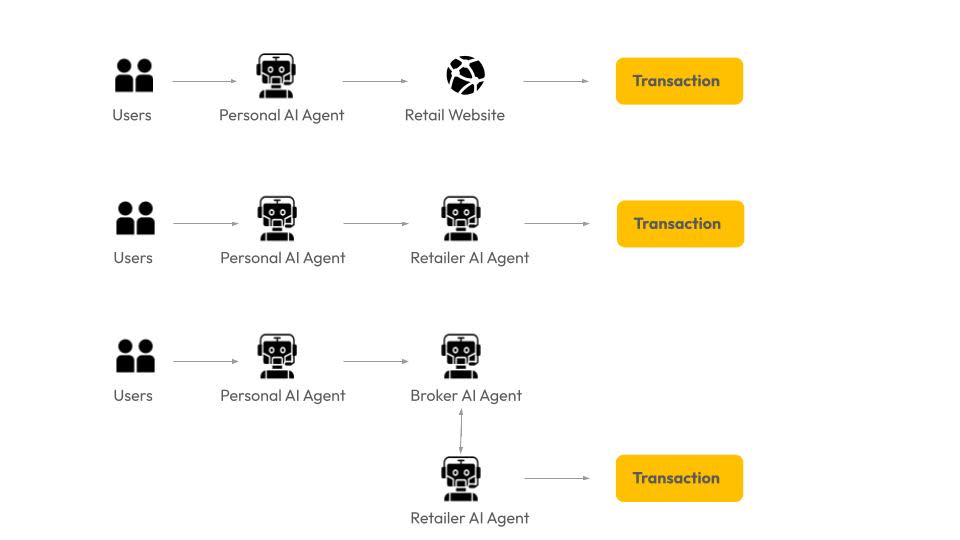
As agentic commerce emerges, we envision a world in which AI agents act on behalf of both shoppers and retailers. Agents interacting directly with the retail website is just the starting point.
Retailers gain more control over customer purchases when their own AI agents push information to other AI agents, prompting a purchase. Agent-to-agent ecommerce is the next step.
As the system matures, we expect intermediaries to emerge to facilitate multi-agent and multi-platform interactions. For example, a wedding planner agent will coordinate across different retail platform agents to purchase the right items for a shopper’s wedding.
How Retailers Can Leverage the New Ecosystem
The emergence of agentic commerce represents a fundamental restructuring of how retail customer relationships are formed and maintained. To respond, retailers need to rethink six core business domains.
Customer Engagement and Product Discovery
Discovery should become continuous, contextual, and commercially optimised by default. Agent-to-agent product suggestions can be dynamically reshaped based on intent discovery, margin and stock position, substitution and bundling.
Opportunity: Discovery becomes a real-time optimisation layer across demand, inventory, and margin.
KPI impact: Revenue per session, inventory turnover, GMROI
Clienteling and Loyalty
Retailers can move beyond static points systems to agent-driven personalisation that responds to real-time customer context. E.g. agents detect life events and trigger relevant offers, adjust loyalty benefits dynamically based on churn risk, and tailor incentives based on behavioural signals rather than fixed tiers.
Opportunity: Loyalty turns into an always-on engagement layer rather than a transactional rewards system.
KPI impact: Customer lifetime value, churn rate, loyalty engagement
Core Commerce Platforms
Commerce platforms must evolve from product catalogues and checkout flows to structured, agent-readable systems. Retailers can introduce a dynamic pricing layer to attract broker agents who assemble the best possible purchase path across cost, speed, and preferences.
Opportunity: The retail platform becomes a dynamic transaction layer that supports machine-to-machine price negotiation at speed.
KPI impact: Conversion rate, average order value, price realisation
Payments and Fraud Detection
Trust and verification must move from point-in-time checks to continuous validation.
Payment systems must evolve to support real-time agent identity verification and behavioural risk scoring. At the same time, payment routing becomes intelligent, selecting the optimal rail based on cost and speed.
Opportunity: Fraud detection shifts left, with agents blocking risky transactions proactively before they occur.
KPI impact: Fraud loss rate, payment success rate, transaction cost
In-Store Point of Service
In-store experiences are no longer isolated from digital journeys. Agents can guide customers through stores, assist sales associates with real-time recommendations, and optimise shelf decisions based on live demand signals.
Opportunity: Physical retail becomes a coordinated extension of the agent ecosystem.
KPI impact: In-store conversion, dwell-to-purchase time, labour efficiency
Fulfilment and Returns
Agents can manage real-time order rerouting based on carrier delays, stock shifts, or environmental disruptions. They can also pre-empt returns by offering automated resolution options for low-value items.
Opportunity: Logistics shifts from rigid execution to adaptive orchestration.
KPI impact: Cost to serve, delivery SLA adherence, return handling cost
How can Retailers Prepare for Agentic Ecommerce
Retail organisations have spent decades optimising shopping experiences around human behaviour, refining every click, scroll, and tap. The challenge now is upgrading existing systems so they provide the structured context, reliable data, and clear interfaces agents need to operate effectively.
Machine-Readable Catalogue (MRC)
Product catalogues need richer semantic and behavioural metadata so agents can understand:
Who the product is relevant for
How it is typically used
What alternatives exist
What customer behaviours are associated with it
For example, instead of a listing simply saying “waterproof jacket,” the system should expose structured attributes such as weather suitability, activity type, insulation level, sustainability preferences, and compatibility with related products. This allows external agents to interpret product intent more accurately, increasing purchase likelihood.
Agent-Accessible Interfaces
Traditional ecommerce systems were built around webpages and manual workflows. Agentic commerce requires APIs and “agent gateways” that allow external agents to programmatically interact with your platforms. This includes structured checkout flows, inventory-aware recommendations, dynamic pricing, and automated fulfilment decisioning.
This does not always require a full platform rebuild. Many retailers can accelerate readiness by placing stable API wrappers around existing legacy systems.
Simulation Environments
Simulation is a key readiness strategy. Retailers can deploy agents in “shadow mode” before allowing autonomous execution. Agents observe live retail operations and make simulated decisions without acting on them. Retailers can then compare agent recommendations against human decisions, quantify performance improvements, and validate ROI before introducing operational risk.
Other Modernisation
As you consider modernisation across the six core domains discussed previously, you can begin to identify additional gaps in existing infrastructure. E.g.
Persistent customer-context layers that enable agents to interact with customers more meaningfully.
Real-time systems for validating agentic identity and intent for fraud detection.
In-store system modernisation with digitised store maps and inventory, and integrated spatial computing for navigation.
Agent-ready fulfilment orchestration APIs for logistics
Final Words - Data Foundation is Critical to Success in Agentic Ecommerce
Agentic systems scale both efficiency and error simultaneously. If product, inventory, or pricing data is unreliable, AI agents will simply make incorrect decisions faster and on a larger scale than humans.
Retailers, therefore, need to prioritise foundational data readiness before pursuing advanced autonomy.
The retail leaders of tomorrow are creating structured, trustworthy, and agent-accessible commerce environments today. At V2, we use a structured Agentic Commerce Readiness Assessment Framework to identify where our clients stand today and how we can help them get to the next level. Our industry-ready fast starts enable clients to realise measurable business value more quickly and at scale.
Contact us to learn more!